
Last updated November 17, 2026
 AC repair
 Furnace & heating
 Heat pumps
 Ductless mini splits
 Carrier
 Trane
 Goodman
Seasonal tune-up and full diagnostic on your Carrier, Trane, or Goodman system - readings shown to you before any repair is proposed
Diagnosis first, numbers second - you approve the repair price before a single part goes in.
Get your free estimateThe Complete Furnace Repair Guide for Sunrise Manor Homeowners
Sunrise Manor homeowners make one furnace mistake that homeowners in colder climates almost never make: they ignore the furnace completely from March through October, skip the fall startup check, and then call for emergency repair on the first 38-degree night in November, when every HVAC company in the valley is fully booked and emergency rates apply. That long idle stretch is exactly what breaks furnaces here. Dust settles in the burners. Igniters corrode. Heat exchangers sit through a hundred-plus days above 100 degrees and then get shocked with a hard first fire. This guide maps the failure patterns we actually see in Sunrise Manor, what the five most common repairs cost at local prices, which work legally requires a licensed contractor in Clark County, and how to hire a company that puts the price in writing before anyone picks up a tool.
Quick Answer
Furnace repair in Sunrise Manor typically runs $150 to $650 for the most common fixes, with igniter replacement at the low end and heat exchanger work at the high end. The failures are predictable: cracked heat exchangers from thermal stress after long idle months, clogged secondary heat exchangers on high-efficiency units from desert dust, and igniters that fail because the furnace only fires a handful of times per season. Most of it is preventable with a September startup check.
Styles & brands we work with
- AC repair
- Furnace & heating
- Heat pumps
- Ductless mini splits
- Carrier
- Trane
- Goodman
Table of Contents
- Why Sunrise Manor Furnaces Fail Differently
- The Three Failures We See Most in Sunrise Manor
- What Furnace Repair Costs in Sunrise Manor
- Clark County Permits and When You Legally Need a Licensed Contractor
- What Our Dispatch and Pricing Process Looks Like
- Repair or Replace? The Sunrise Manor Math
- The Fall Startup Checklist for Sunrise Manor Homes
- Common Mistakes to Avoid
Why Sunrise Manor Furnaces Fail Differently
The climate cycle here is the whole story. A furnace in Sunrise Manor runs maybe three or four months a year, and even inside that window it cycles lightly compared to a furnace in Minnesota or upstate New York. The other eight months it sits. That idle time is not kind to mechanical equipment. Rubber seals dry out. Dust and construction grit from the east valley settle into the burners and the blower compartment. Gas valves sit closed long enough that they can stick on first call.
Then October or November arrives, temperatures drop into the 40s overnight, and the furnace gets a hard wake-up. That first cold snap is when our call volume spikes in Sunrise Manor. We see the same pattern in the older single-story homes off Nellis and Lamb, and in the newer stucco builds out toward Hollywood and Desert Pines: a system that ran fine in February sits all summer, then produces a no-heat call within 48 hours of the first cold night.
Homes here also deal with dust in a way cold-climate markets don’t. The valley gets regular wind events, and whatever particulate is in the air ends up inside your return ducts and, eventually, inside the furnace cabinet. High-efficiency units with a secondary heat exchanger are especially exposed, because that second exchanger has tight passages that collect dust and restrict airflow over time. Restricted airflow makes the furnace run hotter, and a furnace running hotter for longer is a furnace aging faster.
The practical takeaway is simple: in Sunrise Manor, furnace maintenance matters more than furnace hours. A unit that runs 3,000 hours a year is not necessarily in worse shape than one that runs 900 hours but sits neglected for eight months. The neglect is what costs you.
The Three Failures We See Most in Sunrise Manor
1. Cracked heat exchangers from thermal stress
The heat exchanger is the metal chamber that separates combustion gas from the air you breathe (a crack means exhaust can mix into the supply air, which is a genuine carbon monoxide concern). Long idle periods followed by hard first-fire cycles stress these metal panels. In Sunrise Manor, we find cracked heat exchangers most often on furnaces that are 12 to 18 years old and have never had a fall inspection. The unit heats fine, the homeowner notices nothing, and the crack shows up on a combustion analysis. This is not a repair you should treat casually, and we’ll say so plainly: a cracked heat exchanger is a safety issue, and the fix is either a heat exchanger replacement or a furnace replacement, not a patch.
2. Clogged secondary heat exchangers on high-efficiency units
High-efficiency furnaces (the condensing type, usually 90% AFUE and up, common brands include Bryant and American Standard) have a second heat exchanger that pulls more heat out of the exhaust. Those passages are narrow. In Sunrise Manor, dust and the fine grit the desert throws around clog them faster than in a humid climate. The symptom is usually a furnace that short-cycles, trips a pressure switch fault, or shuts off mid-cycle. Cleaning or replacing that exchanger is a real repair with a real cost, and it’s one of the reasons we tell homeowners not to skip the filter.
3. Failed igniters on units that barely fire
The hot surface igniter is a ceramic element that glows red to light the gas. It’s a wear item. On a furnace that fires every day for six months, it fails on a predictable schedule. On a Sunrise Manor furnace that fires a handful of times per season, it fails from sitting: corrosion, dust, and the thermal shock of the first cold fire after months of nothing. Igniters are the single most common furnace repair we run in Sunrise Manor, and they’re usually a fast fix once we confirm the diagnosis.
What Furnace Repair Costs in Sunrise Manor
These are the five repairs we get called for most, with parts and labor broken out. Prices reflect what we quote in Sunrise Manor and vary with unit age, brand, and how accessible the component is.
| Repair | Parts | Labor | Total range |
|---|---|---|---|
| Igniter replacement | $40 – $120 | $100 – $180 | $150 – $300 |
| Flame sensor cleaning or replacement | $15 – $60 | $90 – $160 | $110 – $250 |
| Control board replacement | $180 – $450 | $150 – $280 | $330 – $700 |
| Blower motor replacement | $200 – $600 | $200 – $350 | $400 – $900 |
| Heat exchanger replacement | $600 – $1,400 | $400 – $900 | $1,000 – $2,300 |
A couple of things to know about these numbers. First, the igniter and flame sensor are cheap repairs with big leverage: they fix the majority of no-heat calls, and they’re the ones you don’t wait a week on. Second, a heat exchanger repair at the top of that range is often the moment to ask the replace question, because you’re now putting $2,000 into a furnace that may have another two seasons in it. Third, prices in Sunrise Manor sit at the lower end of national ranges for most of these jobs, but they climb during a cold snap when demand exceeds what crews can cover. That’s the emergency-rate premium our opening mentioned, and it’s avoidable if you book in September instead of the first cold night.
Details on what a full diagnostic and repair visit looks like are on our Furnace Repair in Sunrise Manor page, and if your furnace is beyond repair, we handle replacement too.
Clark County Permits and When You Legally Need a Licensed Contractor
This is the part of furnace work that most guides skip, and it matters. Nevada and Clark County regulate heating equipment repair and replacement, and the rules are not the same for every job.
What you can generally do yourself as a homeowner: filter changes, thermostat batteries, and exterior clearing of dust around vents. What you should not do yourself, both for safety and for code reasons, is work on the combustion side of the furnace, the gas piping, the flue, or the heat exchanger.
Where a licensed contractor is legally required in Clark County:
- Furnace replacement or a new install requires a permit and licensed contractor. Any gas connection work falls here too.
- Flue and venting changes require compliance with the mechanical code and, in many cases, a permit. Venting a high-efficiency condensing furnace is a code-controlled job, not a weekend project.
- Gas line work is regulated and requires a licensed contractor. No exceptions for “I watched a video.”
- Electrical connections inside the furnace cabinet touch the electrical code and belong to a licensed trade.
Igniter swaps and flame sensor cleanings are the gray area: many homeowners could physically do these, but the safety risk on the combustion side, plus the warranty implications if you touch the unit yourself, is why we recommend a licensed tech even for those. And there’s a bigger point. Unpermitted work on a gas appliance can affect your homeowner’s insurance if something happens, and it can complicate a sale later. A written record from a licensed contractor is worth something when you list the house.
What Our Dispatch and Pricing Process Looks Like
We built our process around the thing homeowners here complain about most: not knowing who’s coming, when they’ll arrive, or what it will cost until the tech is standing in the doorway. Here’s exactly what happens when you call Halden Heating & Air in Sunrise Manor, from first contact to paid invoice.
- You call and a real person answers. Not a voicemail tree. Line is open 24 hours a day, 7 days a week, and every call is answered by a live person.
- We book it and give you a live arrival time. No four-hour window. Your technician is background-checked and uniformed, and you can track the arrival to your door.
- We diagnose and write the price before any work starts. You get a written price for the repair before a tool is picked up. Same on every job, without exception. If the number surprises you, we haven’t done our job.
- We do the repair and photograph it. Before-and-after photos, so you can see what we found and what we fixed.
- You get the written guarantee automatically. Every repair comes with a written guarantee and the 365-Day Done Right Promise. If the repair fails, we come back at no charge: free second visit, covered automatically, no arguing.
- You pay the written amount. No door-step price change, no add-ons you didn’t approve.
That’s the Relay Standard in practice, and it’s why we operate under The Relay Visibility Guarantee. You can see the full picture of what we do across heating and cooling on the Halden Heating & Air Sunrise Manor home page. We’re independently owned and operated under the Relay Home Co. network, and our technicians have up to 22 years of experience across major brands including Carrier, Bryant, and American Standard.
One more thing worth stating: the guarantee lives in writing on every job, which is unusual. Most companies describe their guarantee verbally. We put it on paper so there’s a record both of us can point to.
Repair or Replace? The Sunrise Manor Math
The repair-versus-replace calculation here is genuinely different from a cold-climate market, and it’s where a lot of Sunrise Manor homeowners get bad advice from national calculators.
In a cold climate, a furnace might run 5,000 hours a year. Here, it runs a fraction of that. That means the remaining service life of a Sunrise Manor furnace is not simply “years left on the chart.” A 15-year-old furnace in Sunrise Manor may have logged far fewer run hours than a 10-year-old furnace in Denver, so age alone is a poor guide. The better inputs are condition and repair history.
Here’s the framework we use:
- Repair if the unit is under 15 years old, the repair is under roughly $800, and this is your first or second repair in three years.
- Lean toward replacement if the repair is a heat exchanger replacement at $1,500 or more, the unit is 15-plus years old, and you’re facing a second major repair within two years.
- Replace if the repair cost passes half the price of a new unit. A heat exchanger swap that eats half the cost of a new furnace is almost never the right money.
- Replace if the cracked heat exchanger is on a 20-year-old unit and the parts lead time is measured in weeks. Winter arrives faster than that here.
The load calculation is also different. Sunrise Manor homes have shorter heating seasons, so sizing depends more heavily on the cooling load. That matters when you replace: we won’t size by square footage alone, because a mismatched system runs worse and costs more. If replacement is the answer, we do the load calculation, order the equipment, and set an install date. That’s not same-day work, and anyone who promises a furnace replacement the same day is skipping the calculation.
If you’re looking at both sides, our team covers AC Installation in Sunrise Manor as well, and pairing a furnace and AC replacement is often where the best economics sit.
The Fall Startup Checklist for Sunrise Manor Homes
This is the one section we’d print and tape to the furnace if we could. Do it in September or early October, before the first cold snap and before the emergency-rate window opens.
- Change the filter. Every three months, minimum. Desert dust means you should look at it monthly during heating season.
- Clear the area around the furnace. Combustion needs air. Paint cans, boxes, and stored stuff near the cabinet can restrict it.
- Test the thermostat. Switch from cool to heat, set it a few degrees above room temperature, and listen for the burners to light and the blower to come on. If it lights and runs clean, good sign. If it clicks and shuts off, call.
- Check the flue for blockage. Look at the exhaust pipe outside. If a bird built a nest or something is stuffed in it, that’s a carbon monoxide risk. Don’t run the furnace until it’s clear.
- Listen for a new sound. A rattle on startup or a squeal that wasn’t there last season is a bearing or blower issue, and it’s cheaper to fix in October than November.
- Book a combustion check. A technician runs a combustion analysis (measuring the exhaust gas to confirm the heat exchanger is sound and the burner is tuned). This is the check that finds a cracked heat exchanger before it becomes a safety event.
If any step produces a no-fire or a no-heat condition, don’t keep cycling the thermostat hoping it will catch. That’s how a small igniter problem turns into a gas leak concern or a blower failure.
Common Mistakes to Avoid
- Skipping the fall startup check because “it worked last winter.” Eight idle months is the exact window when dust and corrosion do their damage. The system “working last winter” says nothing about this winter.
- Waiting for the first cold night to call. Every HVAC company in the valley is fully booked the night temperatures drop. You pay emergency rates and you wait longer. Book in September.
- Running the furnace with a known cracked heat exchanger. This is a carbon monoxide issue, not an inconvenience. If a tech tells you the exchanger is cracked, don’t wait until payday to address it.
- Replacing a filter with the wrong size or a “high-efficiency” one that chokes your unit. Desert dust calls for frequent changes, but the wrong MERV rating for your blower can restrict airflow and cause the secondary heat exchanger clog we described above.
- Hiring on a phone quote. A price quoted over the phone, sight unseen, is a number designed to get the tech in the door. A written price after the diagnosis is a number that sticks.
- Assuming the cheapest repair is the right one. A cheap igniter swap on a unit with a failing control board buys you two weeks, then a second service call.
- Letting a contractor work without a written guarantee. If you can’t point to a document that covers the repair, you don’t have a guarantee. You have a verbal promise.
See the difference
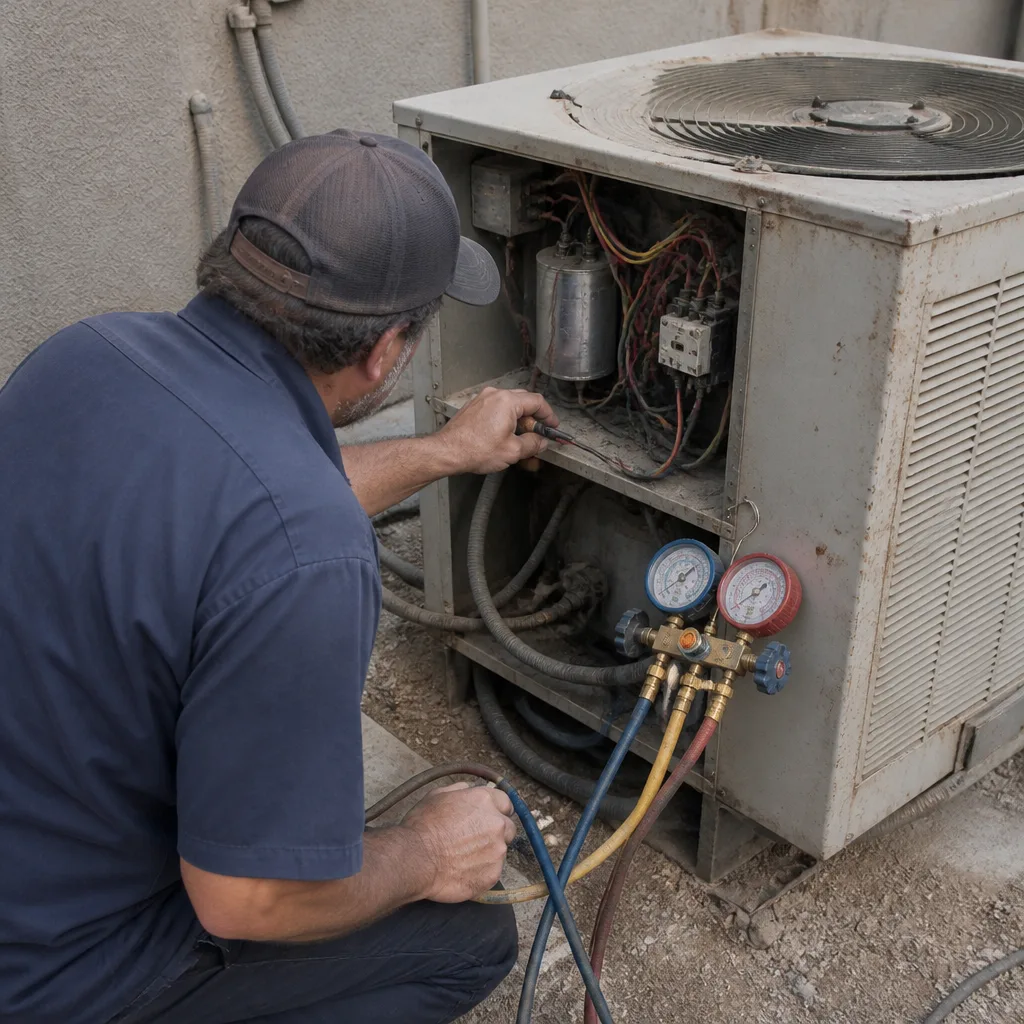 Before
 After
 Before
 After
 Before
 After
When to Call a Professional
Call right away if you smell gas, if the furnace won’t light after two attempts, if the blower runs but the air never warms, if you hear repeated clicking without ignition, or if the unit shuts off mid-cycle and won’t restart. Call in September if you want a startup check before the season. Call before you replace if you’re facing a heat exchanger repair and want a straight answer on the replacement math. And call if you’re getting a door-step quote that keeps climbing.
On anything involving the heat exchanger, gas piping, or the exhaust flue, don’t troubleshoot it yourself. Those are combustion-safety components, and the downside isn’t an expensive repair, it’s a carbon monoxide risk. A licensed technician with a combustion analyzer is the right call every time.
Halden Heating & Air Sunrise Manor offers free estimates in Sunrise Manor. Call (833) 892-8106, a live person answers around the clock, you’ll get a live arrival time you can track, and the written price lands before any work starts.
Frequently Asked Questions
Most furnace repairs in Sunrise Manor run $150 to $650. Igniter replacement is the low end at $150 to $300, flame sensor work is $110 to $250, control boards land at $330 to $700, blower motors at $400 to $900, and heat exchanger replacement at $1,000 to $2,300. Call (833) 892-8106 for an exact quote, because the written price is set after the diagnosis, and estimates are free.
For the most common failures, yes, and we aim for it. Igniters, flame sensors, and control board swaps are stockable items and usually resolved in a single visit. Larger jobs like a blower motor or heat exchanger may need a parts order, and we’ll tell you the lead time up front instead of leaving you guessing. Call (833) 892-8106 and we’ll give you the live arrival time.
Because it sat unused for eight months. In Sunrise Manor, long idle periods let dust collect in the burners, corrode the igniter, and let seals and gas valves stiffen. The first cold snap is the first time the system has run hard in eight months, so that’s when the accumulated wear shows up all at once. A September startup check catches most of it before the cold night.
A like-for-like repair usually doesn’t require a permit, but a furnace replacement, gas line work, and flue or venting changes do, and they require a licensed contractor. Heat exchanger swaps and combustion-side work should be done by a licensed tech for safety regardless of the permit question. Call us for a straight answer on your specific job at (833) 892-8106, free estimates.
Repair if the unit is under 15 years old and the repair is under about $800. Replace if the repair cost passes half the price of a new furnace, if you’re on a second major repair within two years, or if the unit is 15-plus years old with a failed heat exchanger. Our technicians have up to 22 years of experience and will walk you through the math honestly. Call (833) 892-8106 for a free estimate before you decide.
Yes, and they tie together. A furnace sharing ductwork with a struggling AC runs worse on both sides, and a system that’s undersized for the cooling load here tends to work harder on the heating side too. If your cooling is already struggling, our AC Repair in Sunrise Manor page covers that side, and we can quote both in one visit. Call (833) 892-8106 for a free estimate.
The Bottom Line
Sunrise Manor furnaces fail from neglect and thermal shock, not from heavy use. The three failures above (cracked heat exchangers, clogged secondary exchangers, and dead igniters) cover most of what we repair, and the cost table above gives you a realistic picture of what the fix runs at Sunrise Manor prices. You can avoid most of it with a September startup check and a filter you actually change. When you do need a repair, insist on a written price before work starts, a written guarantee on the repair, and a live arrival time you can track. That’s what we do on every job under The Relay Visibility Guarantee, and it’s why the numbers above don’t change when we get to your door.
Call (833) 892-8106 for a free estimate. A live person answers around the clock, and if your heat is out, we’ll get you the arrival time to your door.
Written by the team at Halden Heating & Air Sunrise Manor.