
Last updated November 17, 2026
 AC repair
 Furnace & heating
 Heat pumps
 Ductless mini splits
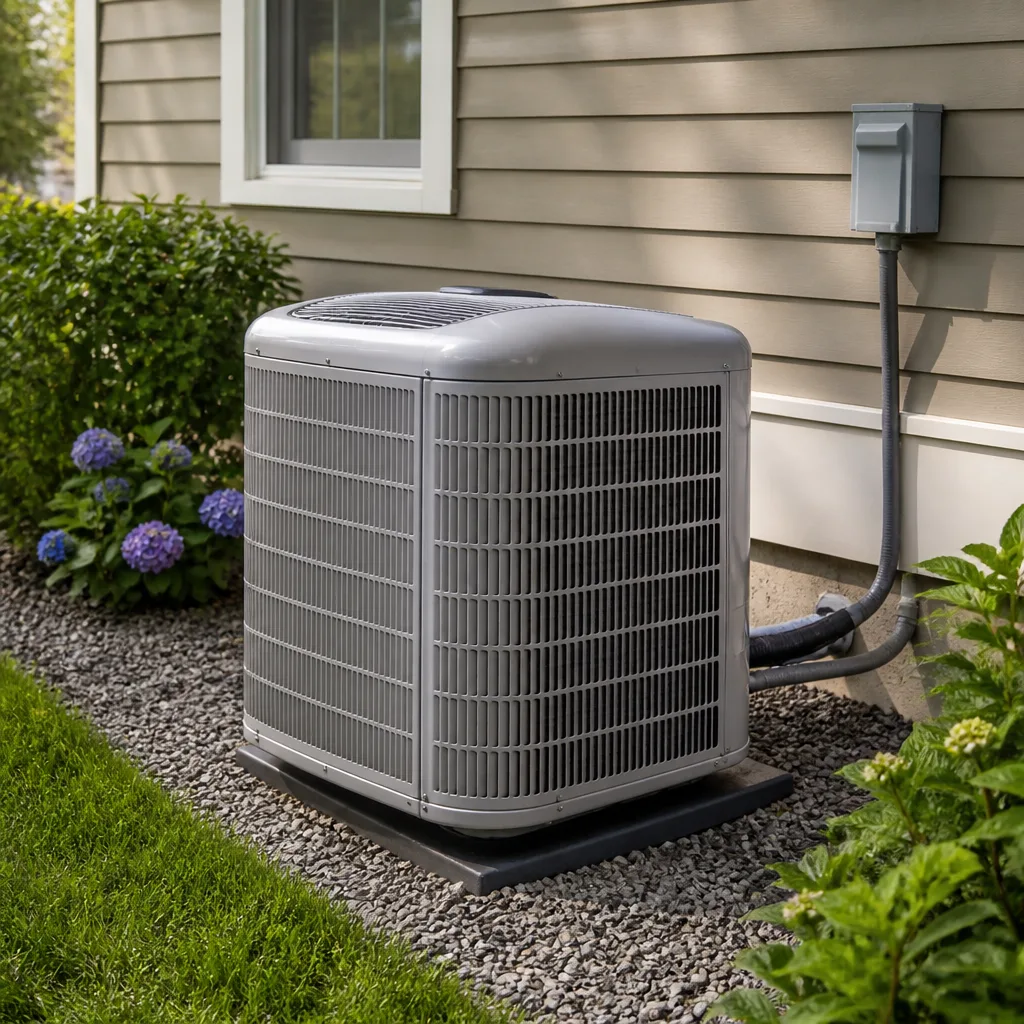 Carrier
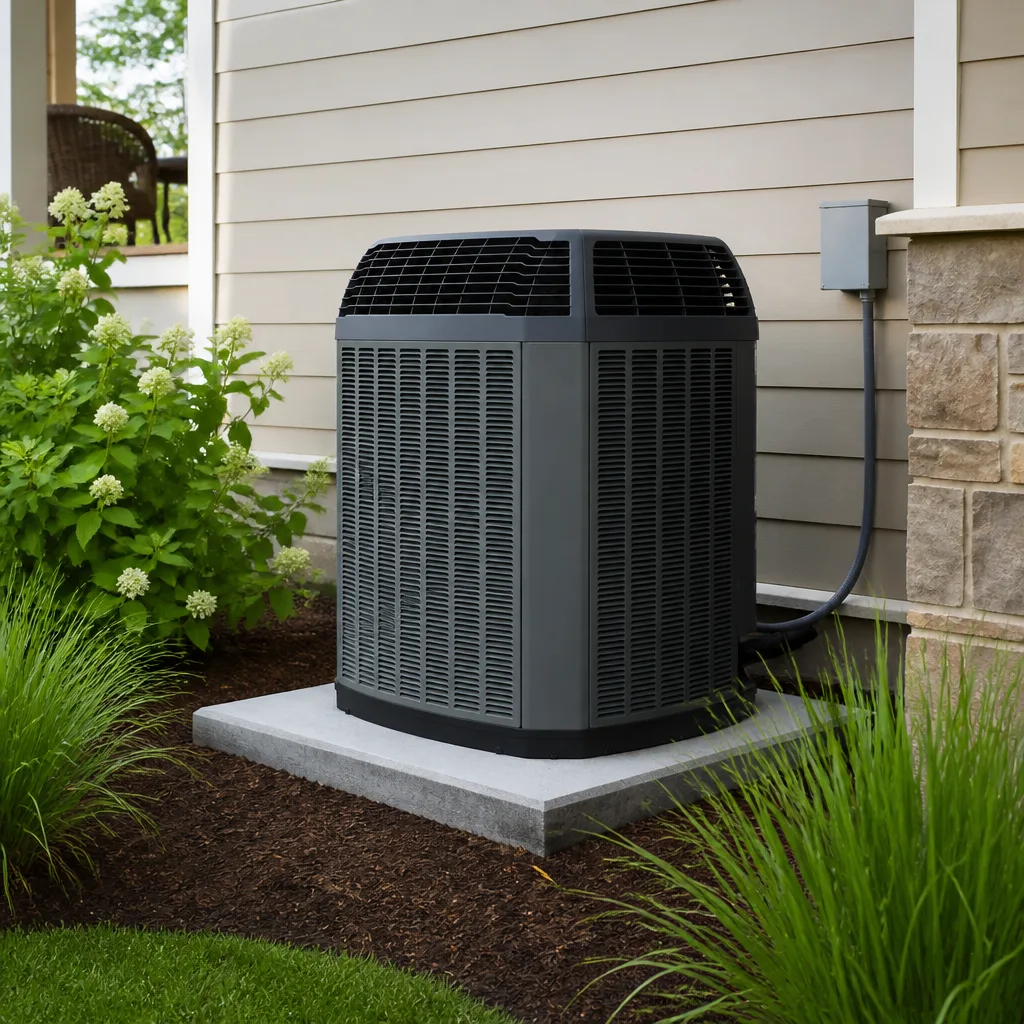 Trane
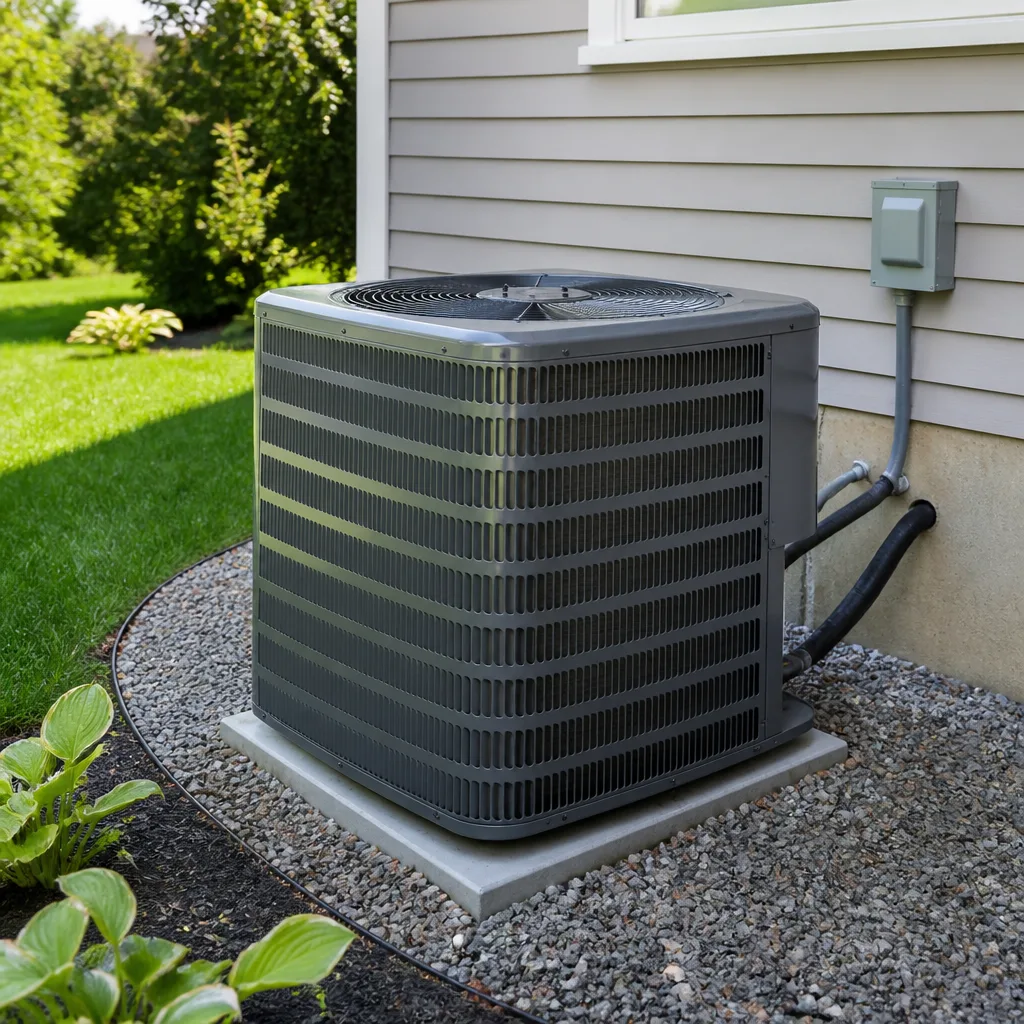 Goodman
Seasonal tune-up and full diagnostic on your Carrier, Trane, or Goodman system - readings shown to you before any repair is proposed
Diagnosis first, numbers second - you approve the repair price before a single part goes in.
Get your free estimateDIY vs Professional AC Repair: What’s Safe to Do Yourself
Replacing a capacitor yourself can save you $180 and takes about 20 minutes with the power off. Handling refrigerant without an EPA 608 certification carries a federal fine of up to $44,539 per day. Both are true, and the gap between them is where most homeowners get into trouble. The real DIY question isn’t about skill level. It’s about which tasks are legal, which void your warranty, and which can quietly turn a $45 part into a $1,400 compressor repair. This guide draws that line in plain language, with the specific warranty language to look for, real part costs, and the tasks we’d genuinely tell a Sunrise Manor homeowner to handle themselves.
Quick Answer
You can safely and legally do the green-zone tasks yourself: filter changes, coil cleaning, condensate drain flushing, thermostat batteries and settings, and clearing debris from the outdoor unit. You can also replace capacitors, contactors, and float switches yourself if you’re comfortable working inside an electrical panel with the breaker off and disconnected. Anything involving refrigerant, compressor work, or opening a sealed system requires an EPA 608-certified technician in Nevada, and most homeowner repairs of that kind will void your manufacturer warranty.
Styles & brands we work with
- AC repair
- Furnace & heating
- Heat pumps
- Ductless mini splits
- Carrier
- Trane
- Goodman
Table of Contents
- Green-Zone Tasks: What You Can Legally Do Yourself
- Yellow-Zone Tasks: Tools Required, No Certification Needed
- Red-Zone Tasks: Federally Restricted or Warranty-Voiding
- Which Parts You Can Buy and Install Yourself
- How to Check if Self-Repair Voids Your Warranty
- The Hidden Cost of a DIY Repair Gone Wrong
- What to Document Before and After Any Self-Repair
- Why Sunrise Manor Heat Changes the Math
Green-Zone Tasks: What You Can Legally Do Yourself
These are the repairs and maintenance steps that require no license, no certification, and no specialized tools. Any homeowner can do them without touching refrigerant or opening a sealed system. In Sunrise Manor, where summer highs routinely push past 110°F and the AC runs 12 to 14 hours a day from May through September, these tasks actually matter more than they do in milder climates. A clogged filter in Las Vegas Valley dust is the number-one cause of frozen coils and premature compressor wear we see on service calls.
- Filter changes. Every 30 to 60 days in summer, not every 90. Sunrise Manor’s dust load clogs a 1-inch filter faster than the manufacturer’s recommendation assumes.
- Outdoor coil rinse. A garden hose on low pressure, power off at the breaker, from the inside out. Do this monthly in summer.
- Condensate drain flush. Pour a cup of white vinegar down the drain line access port every 60 days. Algae growth in the drain pan is a common June failure here.
- Thermostat batteries and programming. Standard AA or AAA in most models. Reset schedules when Daylight Saving changes.
- Debris clearing around the outdoor unit. Keep 24 inches of clearance. In Sunrise Manor, tumbleweed and palm frond accumulation against the condenser is a real airflow problem.
- Supply and return vent dusting. Vacuum the grilles monthly. Blocked returns strain the blower.
None of these touch refrigerant, none require opening the electrical panel beyond flipping a breaker, and none will affect your warranty. They’re the same tasks a technician performs on a tune-up, and doing them yourself between professional visits extends equipment life. If you want a professional baseline, our team handles AC Repair in Sunrise Manor and can walk through what your specific system needs.
Yellow-Zone Tasks: Tools Required, No Certification Needed
These are legal for a homeowner to perform. They’re also where most confident DIYers get hurt, because they involve 240-volt components that hold a charge even after the thermostat is off. A capacitor can hold a lethal charge for minutes after power is cut. We’re not going to give you step-by-step instructions for opening a live electrical panel – that’s the kind of thing a trained technician does with a meter and a discharge procedure. What we will do is tell you which components fall in this zone, roughly what they cost, and what the risk actually looks like.
- Capacitor replacement. The round or oval silver can inside the outdoor unit. Fails in 5 to 8 years in Sunrise Manor heat. Part cost: $15 to $45 online. Technician-installed: $180 to $320.
- Contactor replacement. The relay that switches power to the compressor and fan. Burns out from pitting. Part cost: $20 to $50. Installed: $200 to $350.
- Float switch replacement. The safety switch in the condensate pan that shuts the system off if water backs up. Part cost: $12 to $30. Installed: $120 to $220.
- Thermostat replacement. Low-voltage only, safe if you kill the air handler breaker. Smart thermostats run $100 to $250 for the unit.
The key distinction: none of these involve refrigerant. All of them require the breaker off and the disconnect pulled, plus a multimeter and the knowledge to verify zero voltage before touching anything. If that sentence made you uneasy, that’s the right instinct. This is the zone where hiring a pro is worth more than the parts savings.
Red-Zone Tasks: Federally Restricted or Warranty-Voiding
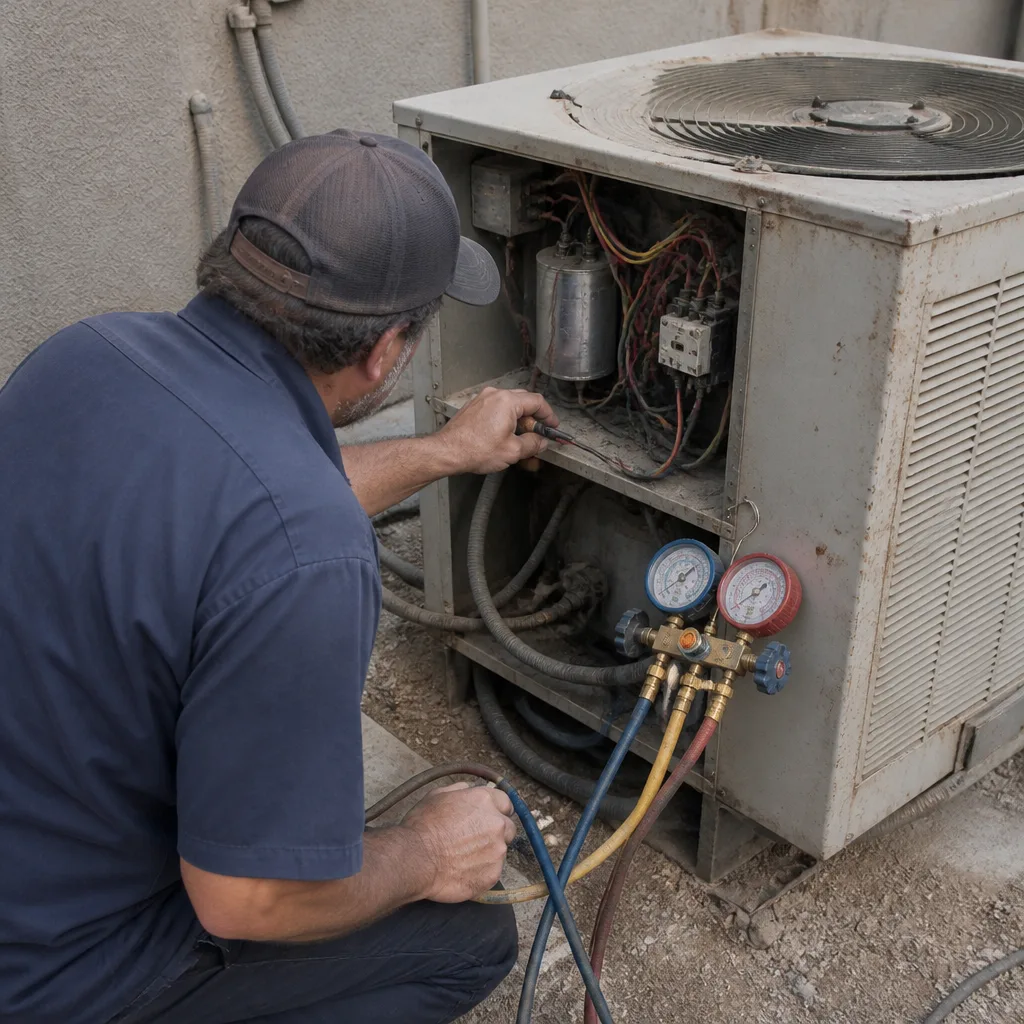
This is where the law draws a hard line, and where “I watched a video” stops being a defense. Refrigerant handling is regulated under Section 608 of the Clean Air Act. It’s illegal for anyone without an EPA 608 certification to buy refrigerant, connect gauges, evacuate a system, or add refrigerant to any residential AC. The fine for a knowing violation is up to $44,539 per day per violation. This isn’t an HVAC industry scare tactic – it’s the same federal law that applies to commercial refrigeration techs and appliance servicers.
- Refrigerant recharge or top-off. Federally restricted. Requires EPA 608 certification plus a recovery machine and vacuum pump. Not a homeowner task.
- Compressor replacement or repair. Requires refrigerant recovery, brazing, vacuum, and recharge. Warranty-voiding if attempted by anyone other than a licensed tech.
- Evaporator or condenser coil replacement. Same as above – sealed system work.
- Expansion valve, TXV, or metering device work. Sealed system. Restricted.
- Refrigerant line repair or replacement. Restricted. Braze joints under nitrogen, pressure test, evacuate.
- Any work that requires opening the sealed refrigerant circuit. This is the umbrella rule – if it touches refrigerant, it’s red-zone.
We’ve seen homeowners in Sunrise Manor try to top off their own systems with refrigerant bought online or through a “friend with a license.” The result is almost always a system overcharged or undercharged, sometimes with contamination that requires a full flush, and a warranty claim denied on the spot. The repair cost from a botched DIY recharge routinely runs $800 to $1,800, versus $250 to $450 for a proper diagnostic and recharge by a certified tech.
Need a system fix that’s clearly out of DIY territory? Our team handles Furnace Repair in Sunrise Manor and AC work across the east valley, with written pricing before anything starts.
Which Parts You Can Buy and Install Yourself
Most AC parts are legally available to consumers. The restriction is on refrigerant and on the sealed system, not on every component. Here’s how the parts stack up on cost and legality:
- Run capacitor. Legal to buy and install. Part cost $15 to $45. Technician-installed $180 to $320. Common startup failure point when the outdoor fan won’t spin.
- Start capacitor / hard-start kit. Legal. $25 to $60 retail. Installed $200 to $380. Helps an aging compressor start in extreme heat.
- Contactor. Legal. $20 to $50. Installed $200 to $350. Pitted contacts cause intermittent “won’t turn on” symptoms.
- Float switch. Legal. $12 to $30. Installed $120 to $220. Safety part – never bypass it.
- Thermostat (low voltage). Legal. $100 to $250. Installed $250 to $450.
- Condenser fan motor. Legal to buy, but installation requires matching rotation direction, capacitor sizing, and blade torque. $80 to $200 part. Installed $350 to $550.
- Blower motor (ECM or PSC). Legal, but wiring is more complex. $150 to $400 part. Installed $500 to $900.
- Filter. Legal. $8 to $30. Always DIY.
- Refrigerant (R-410A, R-32, R-454B). Federally restricted to EPA 608-certified purchasers.
- Compressor. Legal to buy, illegal to install without certification (requires refrigerant work). Part $400 to $1,200. Installed $1,400 to $2,500.
Notice the pattern. The parts themselves are cheap. The technician markup covers the diagnostic, the correct match, the labor under a hot Vegas sun, the warranty on the repair, and the liability if the part fails and takes something else with it. That’s not padding – it’s what makes the repair repeatable.
How to Check if Self-Repair Voids Your Warranty
This is the part almost no one tells you, and it’s where DIY gets expensive fast. Manufacturer warranties on major brands – Trane, Lennox, Goodman, Rheem – all contain a version of the same clause. The specific language varies, but the substance does not.
Open your equipment warranty document (usually a PDF on the manufacturer’s site, searchable by model number on the data plate) and look for these phrases:
- “Damage caused by improper installation, repair, or service performed by anyone other than a qualified, licensed contractor.” This is the standard Trane and Lennox language. Any homeowner repair that causes damage voids the part covered by that damage.
- “This warranty does not cover labor or parts related to refrigerant loss resulting from improper service.” Standard on Goodman and Rheem. If your DIY attempt leads to refrigerant loss, that’s on you.
- “Use of non-OEM parts may void this warranty.” Present on most major brands. Aftermarket capacitors and motors are the biggest exposure here.
- “Service must be performed by a licensed HVAC contractor to maintain warranty coverage.” Usually found in the “Conditions of Coverage” section near the bottom.
The good news: on Trane, Lennox, Goodman, and Rheem, a filter change, coil rinse, or float switch replacement does not void the warranty. The warranty is designed to survive routine maintenance. The exposure is on component replacement that causes subsequent damage, and on any sealed-system work.
One more check before you start: verify whether your specific unit’s parts warranty is 5, 10, or 15 years. The longer the remaining warranty, the more a DIY repair could cost you in forfeited coverage. A system with 7 years left on a 10-year Trane parts warranty has real value – don’t gamble it on a $180 savings. If you’re planning a larger repair and want a written second opinion, our team offers AC Installation in Sunrise Manor consultations and can read your warranty with you before you decide.
The Hidden Cost of a DIY Repair Gone Wrong
Here’s the math that changes how people decide. A failed capacitor replacement is not the expensive part. The expensive part is what happens to everything downstream. In our experience across Sunrise Manor and the east Las Vegas Valley, the pattern shows up again and again: a homeowner replaces a weak capacitor with the wrong microfarad rating or a loose connection, the compressor struggles to start during a 112°F afternoon, the start winding overheats, and the compressor fails.
- Correct DIY capacitor: $20 to $45 in parts, 20 minutes. Done.
- Wrong capacitor, compressor survives but runs hot: $100 to $200 in diagnostics, weeks of higher power bills, reduced compressor life.
- Wrong capacitor, compressor burns out: $1,400 to $2,500 to replace the compressor, or $4,500 to $7,500 for a system replacement if the compressor is out of warranty.
A $45 part becomes a $1,400 repair because of a wrong microfarad rating or a loose spade connector. That’s the risk we’re drawing a hard line around – not because the task is impossible, but because the failure mode is silent and expensive. Similar math applies to contactors (wrong amperage rating, welded contacts) and to any attempt at refrigerant work.
And here’s the honest part: even a well-executed DIY repair can hide a second problem. A bad capacitor often fails alongside a failing fan motor drawing high amps. You replace the capacitor, the motor overheats next, and you’re back inside the unit a week later with no diagnostic baseline. That’s why a proper diagnostic by a technician with 22 years of experience is worth the $89 to $149 service call – they see the second problem before it becomes the first.
What to Document Before and After Any Self-Repair
If you do decide to attempt a yellow-zone repair, document it like a technician would. This matters for three reasons: warranty claims, insurance, and the next technician’s ability to diagnose the system accurately. A system with no service history is a system that costs more to fix.
- Photograph the data plate. Model and serial number, plus the electrical data plate showing rated voltage, capacitor microfarads, and compressor RLA. Before you touch anything.
- Photograph the wiring before disconnecting. Every wire position, every capacitor terminal. Terminals are labeled HERM, FAN, C. Use your phone.
- Record the original part numbers. The capacitor rating (e.g., 45/5 µF), the contactor amp rating, the motor specs. Match exactly – do not “upgrade” to a higher capacitance.
- Log the date and reason for the repair. What symptom prompted it. What you observed (blower running, fan not spinning, etc.).
- Photograph the completed work. New part in place, wire routing, no loose spades. This is evidence if a warranty claim arises.
- Note the system pressures and subcool in your head if you can. You won’t have gauges. That’s fine – some information is only available to a certified tech, and knowing that is useful.
Save the photos in a folder on your phone labeled with the system name and date. If a technician comes out six months later, hand them your folder. They’ll know what was already replaced and can skip straight to diagnosis. That saves you diagnostic time and, in our case, sometimes saves the diagnostic fee entirely. For a full picture of what service looks like when we show up, see Halden Heating & Air Sunrise Manor home.
Why Sunrise Manor Heat Changes the Math
Sunrise Manor sits in the northeast Las Vegas Valley, and the climate here matters for DIY decisions. Summer highs hit 110°F to 115°F for stretches, and your AC runs through a duty cycle lighter than almost anywhere else in the country. Parts age faster. Capacitors that would last 10 years in coastal California fail in 5 to 7 here. Contactors pit and weld. Outdoor fan motors run continuous load from June through September.
That has two consequences for DIY. First, the parts you’re most likely to replace (capacitors, contactors) are ones you’ll replace more often than a homeowner’s guide assumes. Second, a marginal DIY repair fails during a heat wave, not during mild weather. If your AC dies on a 113°F afternoon in July, there’s no “we’ll try again tomorrow.” That’s a health risk, especially with elderly family members or infants, and it’s why we treat summer repair calls with the urgency they deserve.
Sunrise Manor’s housing stock also runs older than the newer master-planned parts of the valley. Many homes here have systems from the 2000s and 2010s that are still on original parts. That age bracket is exactly where capacitor and contactor failures cluster. If your unit is 10 or more years old, budget for one professional service call per year rather than chasing symptoms yourself – the diagnostic catches the three things you were about to miss.
Common Mistakes to Avoid
- Replacing a capacitor without disconnecting power. Pull the plug disconnect and kill the breaker. Wait 5 minutes before touching any terminal. A charged 240-volt capacitor can stop your heart.
- Matching capacitor microfarads loosely. A 45/5 µF capacitor is not interchangeable with a 40/5 or 50/5. The compressor motor winding is sized to the exact rating. Wrong spec equals shortened life.
- Bypassing the float switch because the AC keeps shutting off. The float switch is doing its job – there’s water where there shouldn’t be. Fix the drain, not the safety switch. Bypassing it in Sunrise Manor during monsoon season means a flooded ceiling.
- Self-recharging refrigerant. Illegal without EPA 608 certification. Also usually wrong – the system doesn’t “need more Freon.” It has a leak, and it will lose the charge again within weeks.
- Assuming the warranty is already void. Read the actual language in the Trane, Lennox, Goodman, or Rheem document. A maintenance task does not void anything. Only damage from improper repair does.
- Ignoring the second problem. The capacitor failed because the fan motor is drawing high amps. Replacing the capacitor without checking the motor leads to a second failure in weeks.
- Buying from an unverified online seller. Cheap capacitors with fake ratings are common. Buy from a supply house or verified retailer, and match the part number to the data plate.
See the difference
 Before
 After
 Before
 After
 Before
 After
When to Call a Professional
Call a professional the moment the task touches refrigerant, the compressor, or the sealed system. Call when you’re not comfortable verifying zero voltage with a meter. Call when the system is under manufacturer warranty and the repair is above the green-zone threshold. Call when the symptoms are intermittent and you’ve already replaced a part without solving the problem. Call when it’s 110°F or hotter and you have family members at health risk – speed matters more than savings on those days. Our technicians have up to 22 years of experience across Trane, Lennox, Goodman, Rheem, Carrier, Bryant, Daikin, York, and American Standard systems, and we deliver a written price before any work starts. Every repair comes with a written guarantee and a 365-Day Done Right Promise. Halden Heating & Air Sunrise Manor offers free estimates in Sunrise Manor – call (833) 892-8106 to book, get a live arrival time, and track your tech to the door.
Frequently Asked Questions
Yes. Capacitors, contactors, float switches, thermostats, and filters are legal for homeowners to purchase and install without any license or certification. The federal restriction applies only to refrigerant handling and sealed-system work. If you’re working inside the electrical panel, kill the breaker and pull the disconnect first, and verify zero voltage with a meter before touching any terminal. Call (833) 892-8106 if you’d rather have it handled and guaranteed.
Yes. Section 608 of the Clean Air Act makes it illegal for anyone without an EPA 608 certification to purchase, handle, or add refrigerant to a residential AC system. The fine for a knowing violation is up to $44,539 per day per violation. Nevada enforces federal refrigerant rules. Call (833) 892-8106 – our certified techs handle recharges legally with a written price before the work starts.
It depends on what you did and what damage resulted. Routine tasks – filter changes, coil rinses, float switch replacement – do not void Trane, Lennox, Goodman, or Rheem warranties. Component replacement that causes subsequent damage, or any refrigerant work by an uncertified person, can void the warranty on the affected parts. Read the “Conditions of Coverage” section of your warranty document for the exact language. If you’re unsure, call (833) 892-8106 and we’ll read it with you before you decide.
Capacitors, by a wide margin. Sunrise Manor heat pushes AC systems through longer and harder duty cycles than most of the country, and capacitors fail in 5 to 7 years here versus 8 to 10 in milder climates. Our technicians have up to 22 years of experience and can test a capacitor in 10 minutes. Call (833) 892-8106 for a same-day diagnostic in Sunrise Manor.
Possibly, if the cause is a dirty filter, a tripped float switch, or a tripped breaker. Check those three first – they’re free and legal. If none of those is the issue, the likely cause is low refrigerant (a red-zone repair requiring EPA 608 certification) or a failed capacitor or contactor (a yellow-zone repair). Don’t add refrigerant yourself. Call (833) 892-8106 – same-day diagnostics and a written price before any work starts.
Yes. Every repair comes with a written guarantee, backed by our 365-Day Done Right Promise. If the repair fails within the coverage window, we come back at no charge – that free second visit is automatic, not an extra you have to argue for. We also certify on Carrier, Trane, Lennox, Goodman, Rheem, York, Daikin, Bryant, and American Standard systems. Call (833) 892-8106 for a free estimate on your repair.
The Bottom Line
The safe DIY line is not about how handy you are. It’s about what federal law restricts and what your warranty protects. Change your filter, rinse your coil, flush the drain, keep the outdoor unit clear, and replace capacitors, contactors, and float switches if you’re confident with a multimeter and the power is fully off. Don’t touch refrigerant, the compressor, or the sealed system – that’s a federal certification issue with real fines, and it can void your manufacturer warranty on parts worth hundreds. Document everything you do so the next technician can diagnose accurately. And when the repair is above the green zone and you’re staring down a 112°F Sunrise Manor afternoon, don’t gamble on the wrong microfarad.
Need a professional on a repair that’s outside the safe DIY zone? Call (833) 892-8106 for a free estimate in Sunrise Manor. We’ll give you a written price before any work starts, a live arrival time you can track to the door, and a written guarantee on every repair – all backed by The Relay Visibility Guarantee and our 365-Day Done Right Promise.
Written by the team at Halden Heating & Air Sunrise Manor.