
Last updated November 17, 2026
 AC repair
 Furnace & heating
 Heat pumps
 Ductless mini splits
 Carrier
 Trane
 Goodman
Seasonal tune-up and full diagnostic on your Carrier, Trane, or Goodman system - readings shown to you before any repair is proposed
Diagnosis first, numbers second - you approve the repair price before a single part goes in.
Get your free estimateDIY vs Professional Furnace Repair: What’s Safe to Do Yourself
Replacing a furnace igniter is a 15-minute, $25 repair on most gas furnaces. No gas lines involved, no high voltage, no special tools. Cleaning the flame sensor next to it is just as safe. But the repair that looks almost identical to both of them – adjusting the gas valve – can fill a home with unburned gas if it’s done wrong. The difference isn’t skill. It’s hazard category. In Sunrise Manor, where winter nights drop into the 30s and furnaces run hard from December through February, we see homeowners cross that line without realizing it. This guide draws the line clearly: what’s genuinely safe to fix yourself, what’s safe with caution, and what requires a licensed technician, plus what Nevada law and your insurance policy say about the whole thing.
Quick Answer
Safe DIY furnace repairs are limited to low-voltage, no-gas tasks: replacing the igniter, cleaning the flame sensor, changing the filter, and troubleshooting the thermostat. Anything involving gas pressure, the gas valve, the heat exchanger, or 110-volt electrical components requires a licensed technician in Nevada – both for safety and because unlicensed gas work can void your homeowner’s insurance coverage. Most homeowners save real money on the green tasks and should never touch the red ones.
Styles & brands we work with
- AC repair
- Furnace & heating
- Heat pumps
- Ductless mini splits
- Carrier
- Trane
- Goodman
Table of Contents
- The Furnace Repair Task Matrix: Green, Yellow, Red
- The Legal Side: Nevada Code and Your Insurance
- The Three DIY Repairs That Actually Save Money
- Why Heat Exchanger Checks Are Not a DIY Job
- “I’ll Just Watch a YouTube Video” – Honest Advice
- Filters, Thermostats, and Other Safe Maintenance
- How to Diagnose Before You Decide
- Common Mistakes to Avoid
- When to Call a Professional
- Frequently Asked Questions
The Furnace Repair Task Matrix: Green, Yellow, Red
Most DIY articles treat furnace repair as one big category. That’s the problem. A furnace is really three systems bolted into one cabinet – a low-voltage control circuit, a gas train, and a high-voltage blower circuit – and the hazard level changes completely depending on which one you’re touching. Here’s how we break it down for homeowners across Sunrise Manor.
Green: Safe for a confident homeowner
- Replacing the igniter (the hot-surface part that lights the gas) – low voltage, no gas line contact
- Cleaning the flame sensor (the small rod that proves the burner lit) – same circuit, no gas
- Changing the air filter – monthly during heating season in dusty Sunrise Manor neighborhoods
- Replacing thermostat batteries or resetting the thermostat
- Clearing debris and dust from the furnace cabinet exterior
- Checking and resetting a tripped breaker at the panel (breaker only, not inside the furnace)
Yellow: DIY with caution, specific steps only
- Replacing a thermostat – safe if you kill power at the breaker first and label the wires before disconnecting
- Vacuuming the blower compartment – only after power is off at the breaker, never with the unit live
- Replacing a door safety switch – low voltage, but a mis-wired switch can stop the furnace from running entirely
- Checking the condensate line on a high-efficiency unit – watch for water damage but don’t cut into the drain
Red: Licensed technician only, every time
- Any gas valve adjustment or replacement – incorrect gas pressure causes incomplete combustion and carbon monoxide
- Heat exchanger inspection and replacement – requires combustion analysis and visual access you can’t get with a flashlight
- Gas line work of any kind – including tightening fittings you think are loose
- Blower motor replacement – 110-volt circuit, capacitor discharge risk
- Control board replacement – high voltage and diagnostic sequencing
- Flue and venting modifications – incorrect venting is the single largest CO hazard in gas furnaces
- Any work inside the burner compartment beyond the igniter and flame sensor
The Legal Side: Nevada Code and Your Insurance
Nevada doesn’t have a statewide licensing requirement specific to HVAC technicians, but that doesn’t mean gas work is a free-for-all. Clark County and the state fire code both require that gas appliance installation and repair be performed by qualified, permitted contractors, and gas piping work falls under plumbing and mechanical codes that most homeowners can’t legally sign off on. When you pull a permit for anything gas-related in Sunrise Manor, the inspection is signed by a licensed contractor – not by the homeowner who watched a video.
The insurance piece matters more than most people realize. If a fire, CO incident, or water loss traces back to unpermitted or unlicensed gas work, your homeowner’s policy can deny the claim outright – not reduce it, deny it. We’ve seen this unfold in Sunrise Manor more than once: a homeowner saves $200 on a DIY gas valve adjustment, then finds out the $14,000 repair bill isn’t covered because the work was never permitted. Insurance carriers ask a simple question after a loss: who did the work, and were they licensed? If the answer is you, in your garage, on a Saturday, that’s a problem.
The practical rule: green tasks don’t require a permit or a license. Red tasks do, and no amount of YouTube confidence changes that. If you’re unsure which side a repair sits on, call us and ask – we’ll tell you honestly whether it’s something you can handle or something that needs a truck.
The Three DIY Repairs That Actually Save Money
In our experience, three repairs account for the majority of safe DIY savings on a gas furnace. Here are real parts-versus-labor numbers based on what we see in Sunrise Manor and the surrounding east Las Vegas valley.
1. Igniter replacement
The hot-surface igniter is the most common furnace failure in every brand we service, from Goodman to Rheem to York. The part usually runs $15 to $40 depending on the model. A professional igniter replacement typically costs $150 to $280 including labor and a diagnostic visit. If you’re comfortable with a screwdriver and can identify the correct replacement part for your model number, this is a genuinely safe DIY job. Power off at the breaker first. Never touch a new igniter with bare fingers – skin oils shorten its life.
2. Flame sensor cleaning
The flame sensor is a short metal rod that tells the furnace the burner actually lit. Soot and oxidation build up on it and the furnace shuts off a few seconds after ignition – a “short cycling” symptom. The part costs under $15 if you replace it, but usually you just clean it with fine steel wool or a dollar bill. Professional cleaning runs $120 to $200 as part of a service call. Fully safe to DIY. Do not sand it with coarse grit – you’ll strip the sensing surface.
3. Thermostat troubleshooting and replacement
Half of the “my furnace won’t run” calls we get in Sunrise Manor turn out to be dead thermostat batteries, a tripped breaker, or a thermostat programmed to the wrong schedule. Those cost nothing to fix. Full thermostat replacement runs $180 to $350 professionally, or $60 to $200 DIY for a basic smart model. Safe as long as you kill power at the breaker and photograph the wire labels before you disconnect anything.
Why Heat Exchanger Checks Are Not a DIY Job
The heat exchanger is the metal chamber that separates combustion gases from the air you breathe. When it cracks, carbon monoxide leaks into your ductwork – odorless, invisible, and lethal at concentrations you can’t detect without a monitor. This is the one repair where a homeowner’s visual inspection is genuinely unreliable, and it’s not a close call.
From the outside, a cracked heat exchanger looks like every other heat exchanger. The crack often forms on the back side of the chamber, in folds you can’t see without pulling the assembly, and small cracks open and close thermally as the unit heats and cools. What a homeowner can see with a flashlight is roughly 20% of the surface. What a technician sees with a combustion analyzer, a borescope, and a CO test is the whole picture – and even then, most manufacturers call for pressure testing or visual inspection under specific conditions.
The health math matters more than the repair cost. A cracked heat exchanger replacement runs $1,200 to $2,500 on many residential units, or $4,000 to $6,000 for a full furnace replacement if the unit is older. Carbon monoxide exposure costs far more. In Sunrise Manor, we’ve seen families treat headaches and nausea as a flu bug for a week before a CO alarm caught the real cause. If you suspect a heat exchanger issue – soot streaks, a yellow burner flame instead of blue, visible rust on the chamber, or a CO alarm you’ve had to silence – don’t diagnose it yourself. Get a technician out the same day.
“I’ll Just Watch a YouTube Video” – Honest Advice
We’re not anti-YouTube. Some of the best furnace content out there comes from working technicians who care about doing the job right. But the format has a built-in problem: a video that walks you through a gas valve adjustment in 12 minutes usually edits out the combustion analysis, the manometer reading, and the leak test – the parts that make it safe. Those aren’t the boring middle. They’re the whole job.
YouTube is genuinely helpful for:
- Identifying your furnace model and finding the correct replacement part
- Locating the igniter and flame sensor on your specific brand (Goodman, Rheem, York, Daikin layouts differ)
- Reading your control board’s diagnostic LED codes
- Replacing thermostat batteries, resetting a thermostat, or swapping a filter
- Understanding what a technician is likely to check, so you can ask better questions
YouTube skips the safety steps on:
- Any gas valve or gas pressure adjustment – the leak test and combustion check are usually cut
- Heat exchanger inspection – the borescope and CO readings aren’t in the video
- Blower motor replacement – capacitor discharge safety is often glossed over
- Flue and vent work – code clearance requirements vary and rarely appear on screen
A useful way to think about it: if the video’s creator says “call a pro if you’re not comfortable,” that’s a hint the task belongs above the green line. Watch the video to understand the problem. Then decide based on the hazard category, not on how confident the presenter sounds.
Filters, Thermostats, and Other Safe Maintenance
The bulk of furnace longevity comes from tasks that are genuinely safe for anyone with a screwdriver and a few minutes. In Sunrise Manor, dust from the desert and spring pollen pushes filter changes harder than in most of the country – we recommend a fresh filter every 30 days during heating and cooling season here, not the 90 days on the filter packaging. A clogged filter is the single most common cause of high-limit trips, and it’s a $15 fix.
- Change the filter monthly during peak heating. Write the date on the edge with a marker.
- Vacuum the return grilles in every room – dust collects there first.
- Test the thermostat by setting it five degrees above room temperature and confirming the furnace ignites within a minute.
- Watch the burner through the sight glass for the first 30 seconds after ignition. A steady blue flame is normal. A yellow, lifting, or noisy flame means call us.
- Check for warm air at every register – a single cold room often points to a duct issue, not a furnace issue.
- Confirm the CO alarm outside the bedrooms works by pressing its test button. This is the DIY step that matters most.
None of these require opening the burner compartment, touching gas lines, or dealing with high voltage. They’re the tasks that extend furnace life and catch small problems before they become big ones – especially in an older Sunrise Manor home with a Daikin or Bryant unit that’s been through several winters.
How to Diagnose Before You Decide
Half the decision about whether to DIY or call comes down to knowing what’s actually wrong. Here’s a fast triage sequence.
- Read the control board LED. Most modern furnaces flash a code that maps to a specific fault. The sticker inside the door tells you what each pattern means.
- Check the obvious first: thermostat batteries, thermostat mode (heat vs. cool), furnace breaker, filter condition, and the furnace door safety switch (is the door fully seated?).
- Listen and watch. Does the igniter glow? Do the burners light and then shut off within seconds? A glowing igniter with no ignition points to gas supply or gas valve. Lighting and shutting off within seconds points to the flame sensor.
- Match the symptom to the matrix. Flame sensor symptom goes green. Gas supply symptom goes red.
- Call if the code points to anything you don’t recognize. A technician reading the same code over the phone can tell you in 30 seconds whether the fix is $15 or $400.
If your furnace is failing to heat entirely and you’re in Sunrise Manor, the fastest path to a real answer is furnace repair in Sunrise Manor – same-day scheduling, a written price before work starts, and a technician who’ll tell you the truth about whether the fix is DIY-scale or not.
Common Mistakes to Avoid
- Assuming visible equals safe. The heat exchanger is nearly invisible from the outside, and that’s exactly where the most dangerous failure hides.
- Adjusting the gas valve to “make the flame bigger.” A larger flame is often a sign of incorrect gas pressure – correct pressure produces a smaller, hotter, blue flame. In Sunrise Manor’s high-desert elevation, gas-air mixture adjustments matter even more, and they aren’t a homeowner task.
- Replacing the igniter with fingers, not gloves. Skin oils on a new hot-surface igniter cause early failure – sometimes within a week.
- Skipping the furnace door safety switch check. Half of “furnace won’t start” calls are the door not fully closed after a filter change.
- Running a furnace with a yellow flame. A blue flame is normal; yellow means incomplete combustion and possible CO. Shut the unit off and call.
- Not pulling a permit for anything gas-related. In Clark County, unpermitted gas work that causes damage can void your insurance claim entirely.
- Trusting a YouTube video over a CO alarm. If the alarm sounds and you can’t trace it with the furnace off, that’s not a “check it tomorrow” situation.
When to Call a Professional
Call a licensed technician if you smell gas, hear a rumbling or popping sound from the burner, see soot streaks on the furnace cabinet, notice a yellow burner flame instead of blue, have a CO alarm going off or being silenced repeatedly, or have a furnace that’s short cycling on a flame sensor you’ve already cleaned. Call if the diagnosis points to anything on the red list – gas pressure, heat exchanger, blower motor, control board, or venting. Call if your home is a rental, if you’re not sure the breaker is off, or if you’re the type of homeowner who reads this guide and still feels uncertain about touching a screwdriver to the furnace. That last one is not an insult – it’s the right instinct more often than not.
Halden Heating & Air Sunrise Manor offers free estimates in Sunrise Manor – call (833) 892-8106. Every repair comes with a written price before work starts and a written guarantee, and if the repair fails within the coverage window, we come back at no charge.
If your AC is also on your mind going into summer, our team handles AC repair in Sunrise Manor and full AC installation in Sunrise Manor with the same written-price standard, and every job is backed by our 365-Day Done Right Promise.
Frequently Asked Questions
Yes – safe DIY furnace repairs are limited to low-voltage, no-gas tasks: replacing the igniter, cleaning the flame sensor, changing the filter, and troubleshooting or replacing a thermostat. These tasks don’t involve gas lines, high voltage, or combustion analysis. Anything touching gas pressure, the heat exchanger, the blower motor, or the control board is not safe to DIY. Call (833) 892-8106 for an exact quote on anything above the green list – estimates are free.
Nevada doesn’t require a statewide HVAC license for homeowners working on their own equipment, but Clark County code requires gas appliance repairs and gas piping work to be performed by qualified, permitted contractors. More importantly, unpermitted or unlicensed gas work that causes a fire, CO incident, or water loss can void your homeowner’s insurance claim. Green tasks are fine for DIY; red tasks require a licensed pro. If you’re not sure which side a repair is on, call us and we’ll tell you straight.
Most routine furnace repairs in Sunrise Manor run $150 to $500 depending on the part and the labor involved. Igniter replacement typically lands $150 to $280. Flame sensor cleaning runs $120 to $200. Blower motor replacement is $400 to $800. Heat exchanger replacement is $1,200 to $2,500, or $4,000 to $6,000 for a full furnace replacement. Call (833) 892-8106 for an exact quote – we give you a written price before any work starts.
Because the video can’t show you what the technician sees. A cracked heat exchanger is usually on the back of the chamber, opens and closes thermally, and requires a combustion analyzer, borescope, and CO test to confirm safely. A flashlight shows you roughly 20% of the surface. A missed crack leaks carbon monoxide – odorless, invisible, and dangerous at concentrations you can’t detect without a monitor. If you suspect a heat exchanger issue, shut the furnace off and call (833) 892-8106.
The general rule: if the repair costs more than a third of a new furnace and the unit is over 15 years old, replacement usually wins on total cost. If the unit is under 10 years old and the repair is a $200 igniter or flame sensor, repair is the right call every time. For a cracked heat exchanger on an older furnace, replacement is often the smarter move. Call (833) 892-8106 and we’ll walk you through the numbers honestly – free estimate, no pressure.
Usually yes. A furnace that lights and shuts off within 5 to 30 seconds is the classic flame sensor symptom – a $15 part or a 10-minute cleaning. Power off at the breaker, locate the sensor (short metal rod in front of the burner), clean it with fine steel wool, and reinstall. If the problem comes back after cleaning, or the flame never lights at all, that’s a red-list call. Reach us at (833) 892-8106 and we can talk through it.
The Bottom Line
The DIY-versus-professional question isn’t really about skill level – it’s about hazard category. Igniters, flame sensors, filters, and thermostats are green: safe, cheap, and worth doing yourself. Gas valves, heat exchangers, blower motors, and anything inside the burner compartment beyond the sensor rod are red: dangerous, code-regulated, and insurance-relevant. The yellow zone in between is where we see the most mistakes, and where a 30-second phone call saves the most money. In Sunrise Manor, every winter produces a handful of DIY heat exchanger calls that should have been a service visit. If you’re on the fence, we’re here – Halden Heating & Air Sunrise Manor home has the full picture of what we service and how we price it.
If you’ve read this and you’d rather have a professional handle it – or you’ve hit a symptom you can’t place – call (833) 892-8106 for a free estimate. Halden Heating & Air Sunrise Manor will give you a written price before any work starts, a written guarantee on every repair, and a background-checked, uniformed technician with a live arrival time you can track to your door.
Written by the team at Halden Heating & Air Sunrise Manor.
See the difference
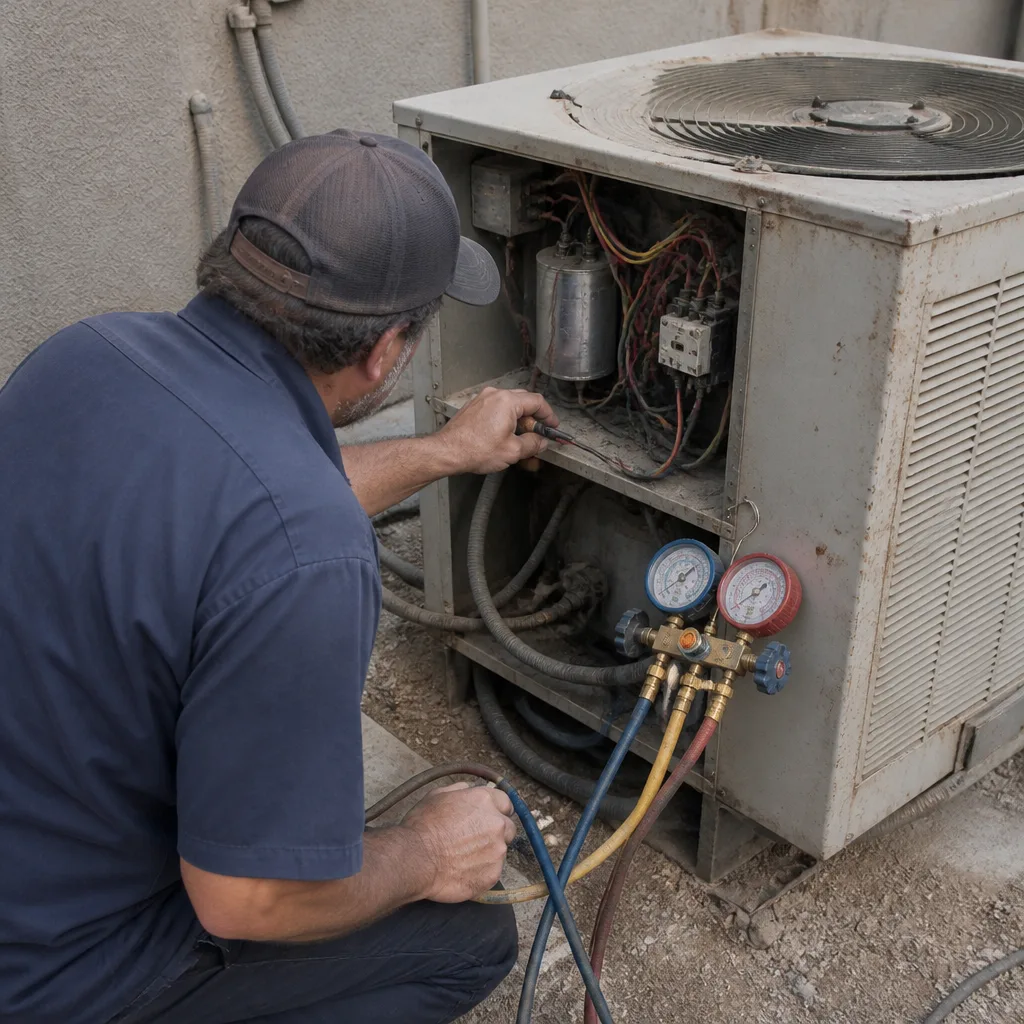 Before
 After
 Before
 After
 Before
 After